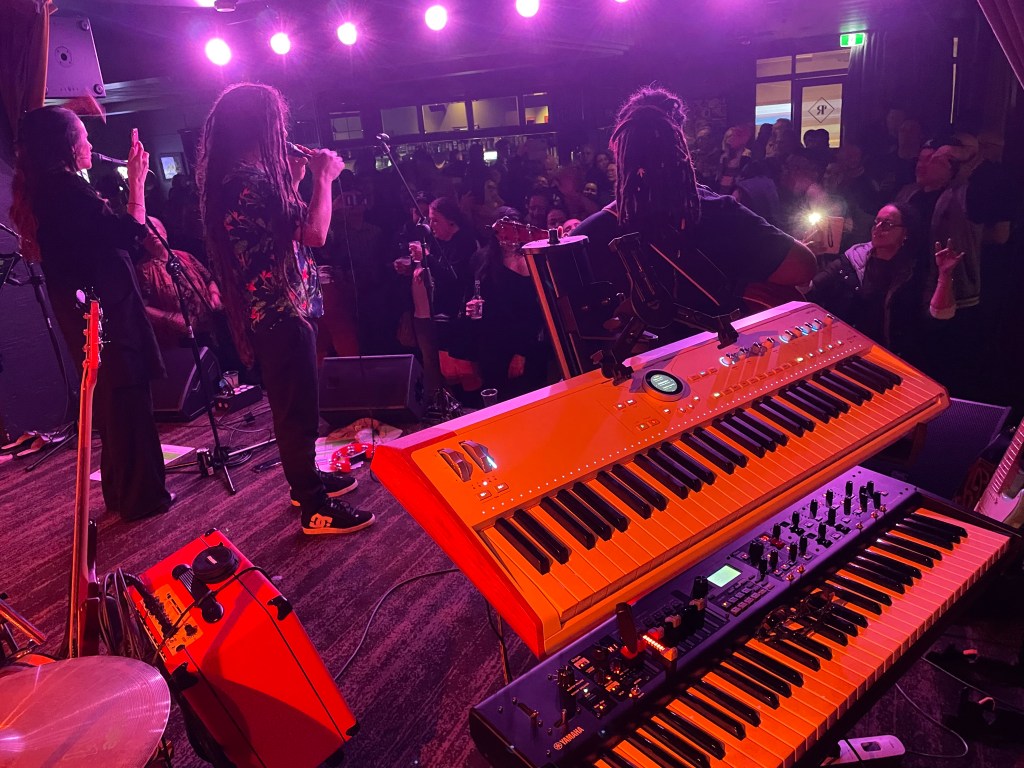
I just realised that I never did a Part 2 post about the Mackay and Emerald shows. It’s a couple of months back now, and becoming a bit of a blur. Sorry. I haven’t felt like writing at length for a long time, so instead I’ve been making short posts about Wookie, my garden, and even baking bread! But I don’t want my blog to be like that.
People say writing about a thing helps you work out what you really know, as well as what you don’t know.
So I’m going to write about what I’ve learnt — and am learning — as a keyboard player in a reggae band. It’s been a steep learning curve since I first joined Roaring Lion in 2021 having only heard three Bob Marley songs before.

I brought my Korg Kross 2 61-keys to the audition. I had it because I was in a country band in Kooralbyn for a while, Cannon Creek Country Band, and auditioned for that band with my Hammond 44H melodica. It was a total fail, it’s hard to comp for a whole set on a melodica. But the lead singer David Barnes brought out a small keyboard and said: please consider playing this. I did, and I liked it. So I picked up my Korg. It was in a clearance sale, did the job for gigging, and only weighed three kilograms. Done.

So that’s what I rocked up to the Roaring Lion audition with, the Korg Kross 2 61. There’s a big Korg digital piano in the left of the top photo, that belonged to the other keyboardist in the band.
So initially our roles were divided into bubble and skank, and creative keys. I was told creative keys is about playing all the accents in a song — little soundbites from horns, strings, maybe a sax solo, that sort of thing. Bubble and skank is part of the rhythm section, and initially was not my responsibility.
So I saw myself as a mini-orchestra. It was fun! I was now listening to about 40 Bob Marley songs, and noting down licks on various instruments, finding a suitable patch on my Korg Kross 2 and learning how to save that into a Favourite bank, for easy access. On the KK2 I basically used a grand piano, electric piano, organ, pan flute, tenor sax, brass section, string section, and a synth lead.
Because it’s just one keyboard, I learned to split the board for a few songs like Exodus (piano and horns), Easy Skanking (clavinet and piano, plus switch to a sax patch for a bridge), Could You Be Loved (clavinet and epiano). That kind of thing.
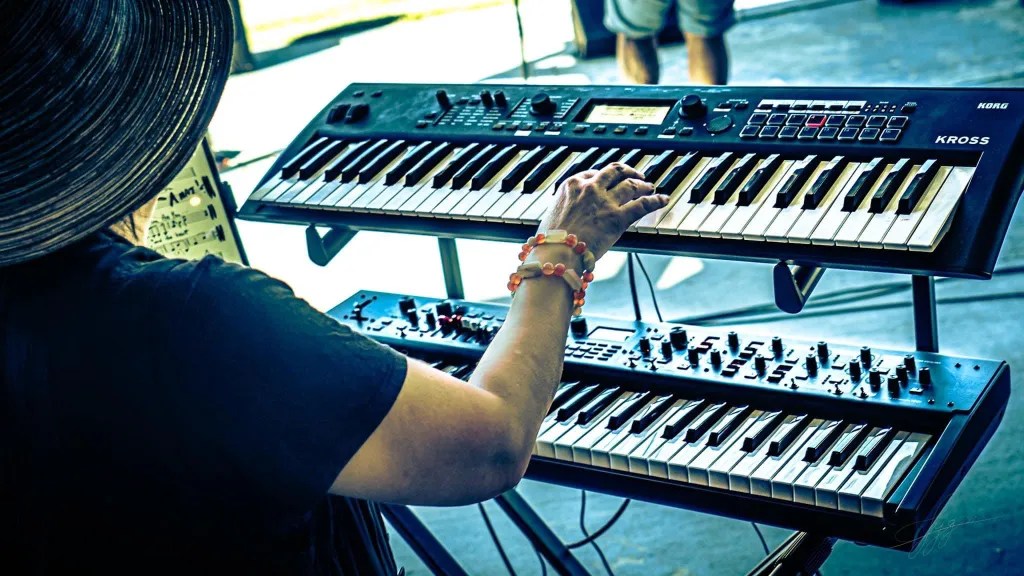
Later, the bubble role came to me, and I bought a Yamaha YC61, which is a stage organ. Honestly, I feel quite guilty that such a gorgeous instrument is being used in such a pared down way — basically using just drawbar 3 plus a tiny bit of the lower or higher drawbars 😳. That keyboard is now split too. The lower part is dedicated to bubble while the upper part is two acoustic pianos layered, one an octave higher, so that one-handed skanking sounds like two hands.
The way I learn a new song is so different now. For dinner jazz playing, you broadly play the melody in the last three fingers of your right hand while crushing in a bunch of supporting chords with all the other fingers —sorry that sounds so rough! But in this role you listen out for specific bits and when they happen.
A song might only have two chords in it, and you think well that’s going to be easy. But you still have to hear (and feel) where and how to play your parts. It’s a different kind of awareness.
Recently I replaced the Korg. After a few years I feel less like I’m frantically treading water, and have started to pay attention to the quality of the sounds I play — could they be brighter, or grainier, or breathier? I found it hard to edit sounds on the Korg, having to use menus and press Shift, Function, Page, Tab across, scroll down etc. After that, not even knowing the word to describe what I am trying to adjust!
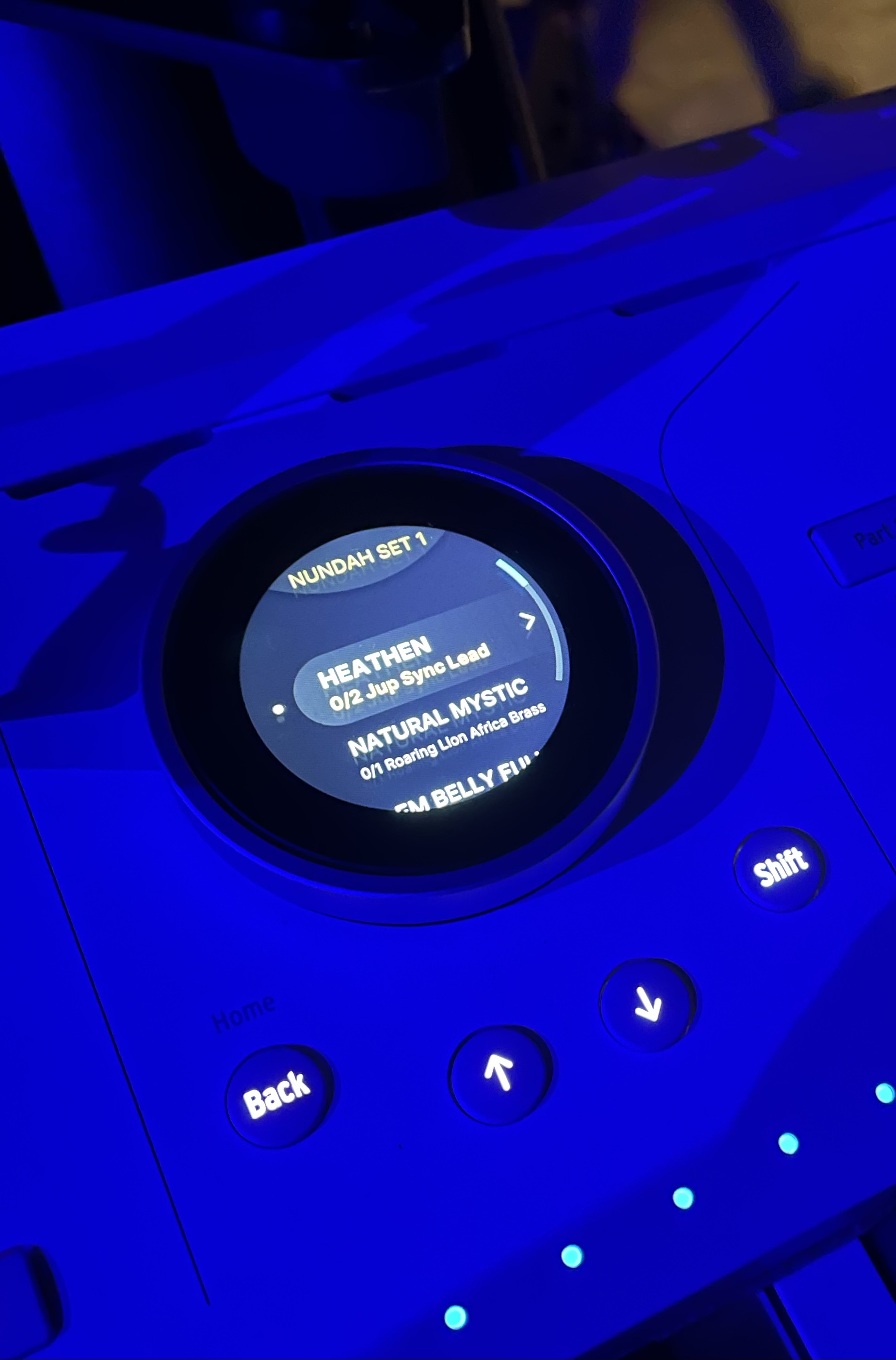
Knowing I wanted to change the musical quality of my patches, Mike put me onto Arturia’s new AstroLab. It’s hardware in the form of a gorgeous keyboard, to play Arturia’s huge collection of sounds, and made for live performance – not so many dials on the instrument. Do all your tweaking at home, by connecting AstroLab to a computer, then opening Analog Lab software to edit patches. When you have finished, save the edited patch (called a preset) to AstroLab’s library. From there you can move the preset to a Playlist which you will be able to see within the keyboard menu.
Anyway I’ve just dumped a bunch of thoughts here, to flesh out in future posts. They won’t be interesting posts for anyone, unless they’re doing a similar thing. Then maybe we can inspire each other!

 Joanna Funk
Leave a Reply