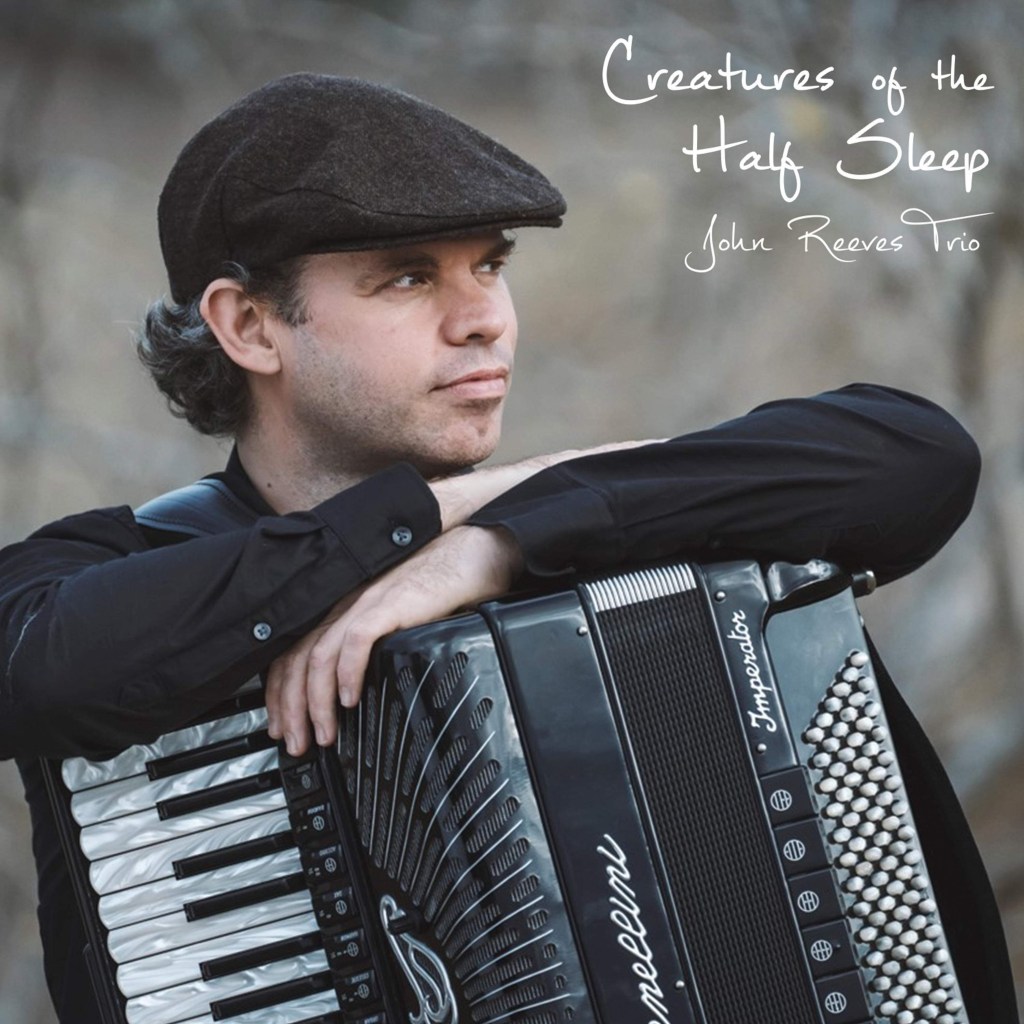
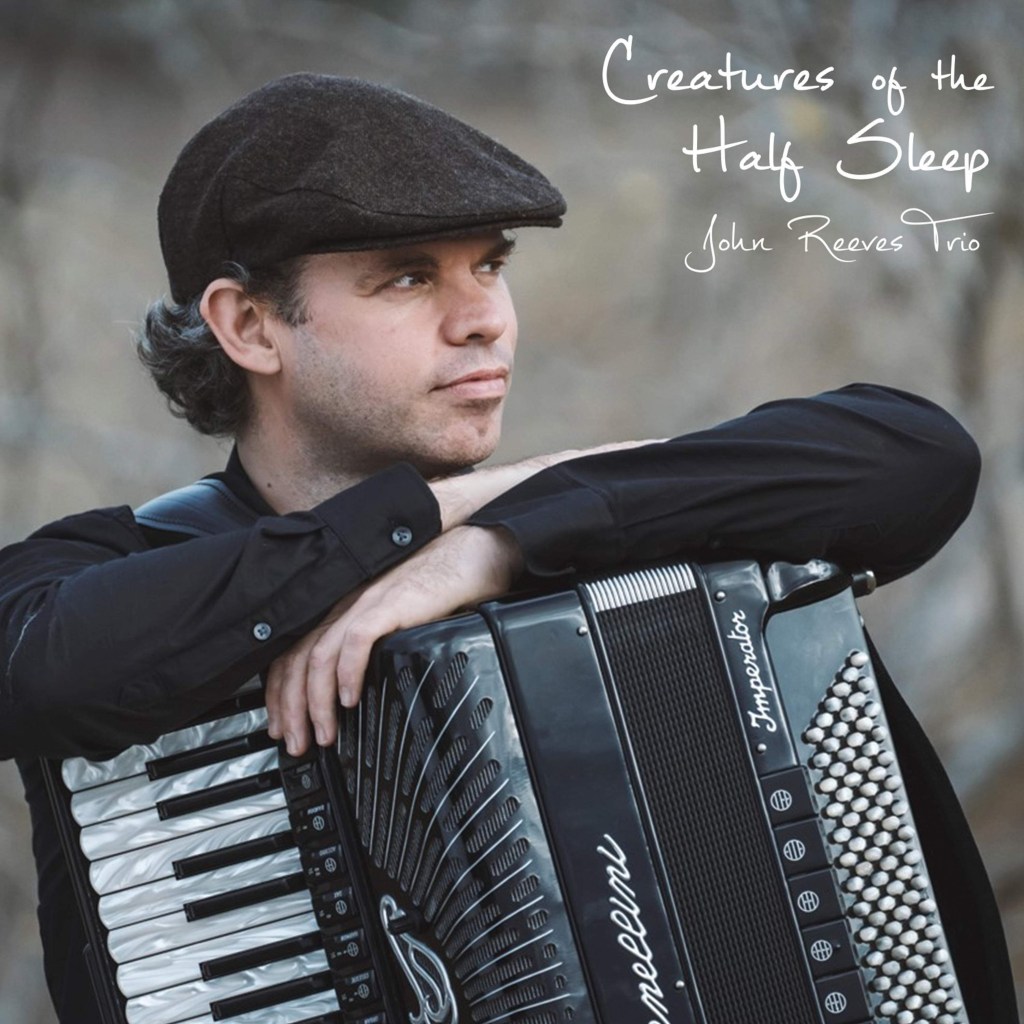
Step into the world of jazz pianist John Reeves, who is releasing his first CD ‘Creatures of the Half Sleep’, a collection of original compositions arranged for accordion! Here, we geek out over his beautiful instrument, and his journey with it so far.
The John Reeves Trio has Helen Svoboda on double bass and Aaron Jansz on drums as well as John on accordion. It was recorded and mixed by Marly Lüske at Alchemix Studios in West End, Brisbane.
I thought this album might have a touch of random oddity that is so British. John didn’t disappoint:
The title tune ‘Creatures of the Half Sleep’ was originally inspired by the sound of a squeaky gate! I thought: Oh, that sounds interesting and I tried to sing it and write a melody. Then I tried to hear where it would lead, and I could hear a kind of African 6/8 beat and it evolved from there.
I think what stands out in all my compositions is that there’s something that links them all together. Even though they’re not made with the same basic material, people say: “Oh yeah, that sounds like one of your tunes.” I want to explore different sound worlds and tonalities, but I still want it to be connected to the normal world. So I use something recognisable with something slightly different. It doesn’t always sound strange, but sometimes it might be a bit left field.
An accordion looks like a keyboard but you’re just opening holes with those buttons. It’s about the wind. The bellows are like lungs for your instrument. The beauty is you can’t hide; it’s like a stringed instrument with a bow – any quiver in your arm is reflected in the sound. There is possibility for infinite colour, and you can make the note completely die away so you’re not quite sure when it really finished…
John Reeves
Wherever I play, someone always comes up to me and says one of their relatives from the distant past used to play the accordion, almost everyone knows someone who played it!
I played a clarinet as a kid, and I feel the accordion is a bit like a piano and a clarinet. I get the impression that when people think about the accordion, they hear certain kinds of music. Like French musette, with the special tuning on the reeds, or they hear tango, or Celtic folk music. Because I’m a jazz musician, I’m using the accordion to play jazz, and working out what it can do in that format.
John listed some of his influences in jazz accordion. I was surprised, there were so many!
As far as famous jazz accordion players are concerned, once you start digging, there are heaps of them! Overseas, there are conservatorium courses for playing the accordion, people that learn the concert accordion and play Bach and all sorts of classical music. Richard Galliano is a French accordion player who is very famous over there. But one of my first inspirations was a guy called Frank Morocco, he only passed away a few years ago. He was a piano accordion player in the States. He played in a kind of fifties jazz style, almost like he was playing a piano.
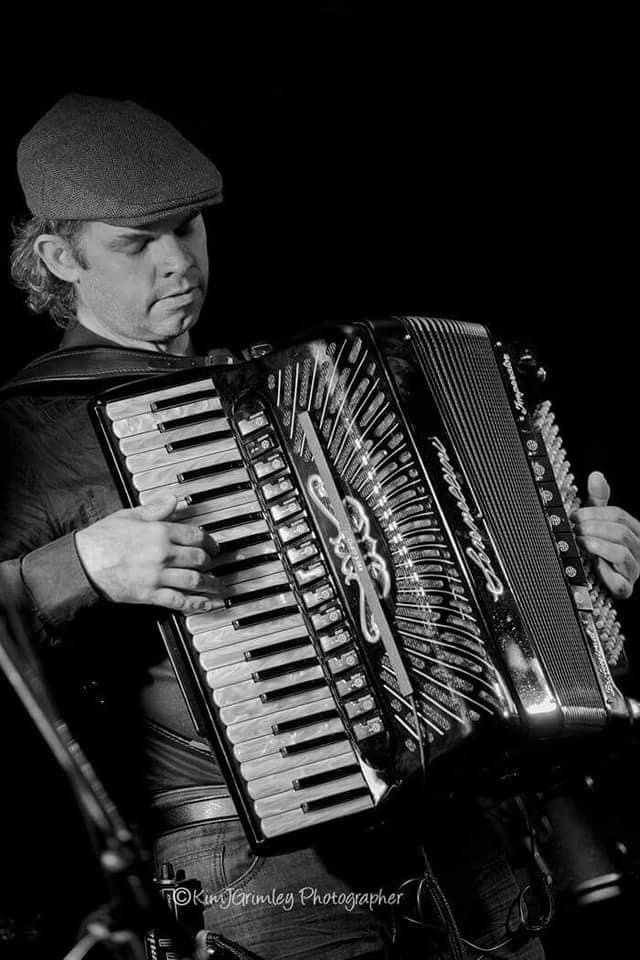
John explained how he gets around the limitations of the accordion’s left hand, which plays basic triad chords, to create more complex jazz chords.
The ‘oom-cha’ box on the left hand side has buttons for bass and chords. But you can mix them to make jazz chords, which is what I do a lot. Like you can have a triad with another bass note. But the Classical accordion – which unfortunately is not what I play – has a switch which changes the standard left side into a whole other keyboards so they can play fully contrapuntal music. It’s quite something! I think in Europe, maybe France and Austria and places like that – I don’t know specifically where – accordion is alive and well!
So what does John play? Time to geek out on accordion.
I now play a Serenellini accordion which was made in Italy. It’s an Imperator model, 120 bass, Stradella system, with 4 reeds in the treble. LMMH (Low Middle Middle High in octaves).
I’ve had it about two years. It cost me just over ten grand, and I bought it from a guy in Brisbane, on Gumtree! He bought it from the factory, and it was in perfect condition. He was a Croatian or Serbian guy, and he bought it because he wanted to treat himself and have this lovely accordion. He was a good player, but he said he just wasn’t playing it enough to warrant owning it so he was selling it. I tried to knock him down on the price but he said, “No, I know how much it’s worth”. He’d had it for about two years before I bought it.
John’s relationship with accordions began as did many pivotal moments in history: at a mate’s house after a curry and a few beers.
My friend handed me his dad’s old accordion. He said, “Go on John. Have a go on that.” I found a couple of chords to do an “oom-cha-cha” and then just sang over the top in a ridiculous fashion. A few months later I bought a cheap one over the internet. It was a Cassini, which sounds Italian but is made in China. It was basically a very well made accordion with cheap parts. It functioned excellently, and was exactly the right thing to start with. The bellows were nice and tight, and it was really in tune. There’s a musette setting where you’ve got two reeds and they’re the same note but they’re slightly detuned, so you get that tremolo sound – you’d know the sound. So that was tuned really well, and it was very light. I was vigourously trying to control the thing and was pulling haphazardly, and didn’t know how to work it. This poor thing was getting pulled around, but it did the trick. It was consistent, and I’m really glad I got it.
After that I got another one which was made in the 50s or 60s. It was a Titano, which is a well-known brand of accordion made in Italy. That was a lovely old thing. I got it from a guy on the Gold Coast. I went down there and played it. I was listening to it and it was a little bit wonky, but the tone of it! Something about it made you feel: Okay, this is what they are supposed to sound like! Because I really hadn’t had a chance to play many accordions, I had no idea really. So I bought this one, and took it to a repairer down in Coffs Harbour. He tuned it up and mended it.
There are little leathers inside which make sure which way the air’s going. So there are two reeds for each note. One plays when you are pulling the bellows out, and the other one plays when you are pushing the bellows in. You don’t want one of them to sound when the other one is sounding. So there’s a leather flap that closes one off while the wind goes past the other one.
John Reeves
When the leathers get old and dry, or aren’t used, then they start to curl up and dry, and funny sounds start to come out of the instrument. So this guy fixed that all up and I used the Titano for the next couple of years.
I’ve ended up playing loads of gypsy jazz with accordion. I’ve always found the music joyous but the piano didn’t quite fit with that sound. So playing the accordion has been wonderful for that and I do that in the Shenton Gregory Quartet. In Estampa I have always played accordion, and I have learned how to play accordion in that band, teaching myself, having a lot of experience performing, and working out what I can get away with and what I can’t. In the last year or two, I’m starting to feel that I’m able to say what I want to say a bit more, so it now seems worthwhile doing a recording.
This CD is a really good mark in time. It’s a good record of my composing, and interplay with other musicians, improvising. It’s very much a jazz trio, imagine a piano trio but the piano exchanged for an accordion. The piano trio has always been my natural habitat.
Over the years I’ve been fortunate enough to get nice feedback when my compositions are played in different groups. Afterwards people come up and ask, “Have you got these recorded so I can buy them?” Finally I can say, ‘Yes I have!’
John Reeves
The CD launch of ‘Creatures of the Half Sleep’ is at the Brisbane Jazz Club April 8. Details on the BJC Facebook page.


 Joanna Funk
Leave a reply to Alan Brinton Cancel reply